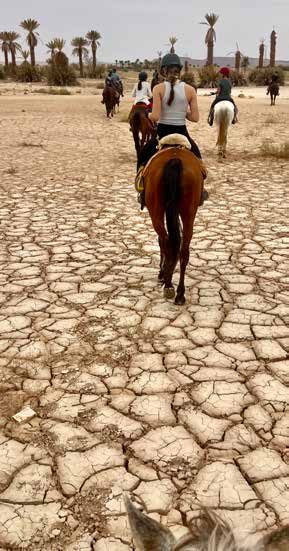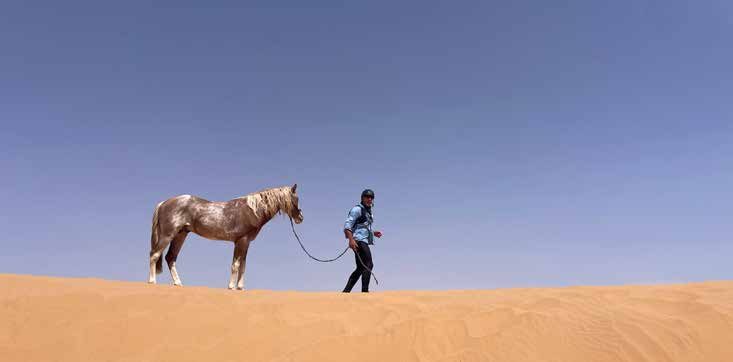
I have just returned from a desert horse-riding trek through the Moroccan Sahara long days in the saddle, endless horizons, and the kind of silence you only find far from everything.
et what caught my attention most was a strange pattern etched across the landscape: evenly spaced, mole-like mounds stretching for tens of kilometres across the desert floor. Curiosity got the better of me. I asked our guide what they were. What I discovered was remarkable. Beneath the arid deserts of southeastern Morocco lies a hidden marvel of engineering: the khettaras of Fezna. These ancient underground aqueducts, some stretching
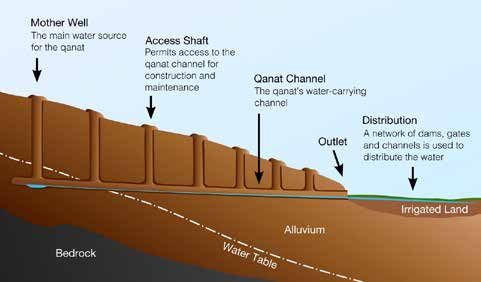
for tens of kilometres, have sustained oasis communities for centuries. Dating back to around the 11th century, these systems were inspired by earlier Persian and Yemeni designs, adapted to the North African landscape. Rather than transporting water above ground, khettaras draw it beneath the surface, protecting it from sun and evaporation. Each system begins high in the foothills, where a deep “mother well” is sunk often 20 to 60 metres or more until it
reaches a sloping underground aquifer. This aquifer, a layer of water held within gravel and sand, angles downward away from the mountains. The khettara tunnel intercepts this water source and follows a gradient, allowing water to flow by gravity towards the oasis. Along the route, a series of vertical shafts typically 5 to 20 metres deep and around a metre wide punctuate the landscape in a straight line. These shafts were essential during construction and
Drilling and developing boreholes in Greyton since 2019.
remain vital for ventilation and maintenance. Seen from above, they appear as a chain of dots across the desert. The underground tunnel itself is modest: typically 0.5 to 1 metre wide and about 1.2 to 1.8 metres high just enough for a worker to move through. Despite its scale, this narrow passage can carry water over extraordinary distances. By the time the water reaches the surface,
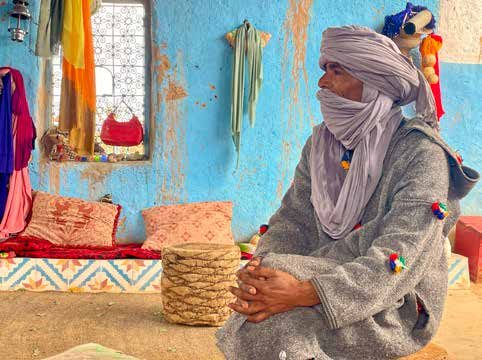
it emerges into irrigation channels, feeding palm groves, crops and homes. In Fezna and the wider Tafilalt region, these systems were and in some cases still are the foundation of life. Importantly, khettaras were managed collectively. Groups such as the Amazigh, including the Ait Atta and Ait Khebbach, as well as Haratin communities, shared water through carefully regulated timebased rights.
(Attribution https_thecivilengineer.org)
What makes the khettaras remarkable is their efficiency. Without machinery, they harness geology and gravity to move water across distance. Today, many have fallen into disrepair, yet they remain a reminder of human ingenuity working with the landscape, not against it, to sustain life in one of the world’s harshest environments.